St. Louis is famous for cool traditions but also for our resistance to change. Soon we will be asked to overcome that resistance and pull together as a community to carry out a transformation of our downtown's riverfront area.
We are in the midst of an historic design competition. The work of world class design teams will soon build a vision to transform our downtown, the Arch grounds, and riverfront. The results offer the potential to be the crowning achievement of more that 25 years of downtown revitalization. The elusive dream of a riverfront and Arch grounds which are connected to downtown and active with people is on the brink of coming true.
It has taken a lot of work to get us here. Civic leaders pushed for years to make this happen. They convinced the National Park Service and the City of St. Louis to sponsor an international design competition to reinvigorate the Arch grounds. That competition has drawn the brightest talent from around the world to focus on our downtown, riverfront and the Arch - and the too long neglected east bank of the river. Soon the five teams will be releasing their plans to the public and the jury will be tasked with making the decision to select the winning design.
Then the challenge will be on St. Louis and the region to follow through to make it happen. It will take all of us working together as a region to raise the money and will to get this done. St. Louis is famous for completing plans that are never carried out. We can't let that happen this time.
This time we need to follow through on the hard work that got us here to make the dream a reality for the future of St. Louis. Everyone has to be in the boat and pulling in the same direction. We need to ask ourselves, our neighbors, and our community organizations what we are willing to do to make it happen?
The program to transform the Arch grounds and riverfront is an opportunity to bring the St. Louis region together in many new partnerships. These are exciting times and we are on the brink of doing something very special. This project has the potential to not only transform the built environment and experience of the downtown and east bank area but ultimately to make us better people as well.
Wednesday, June 30, 2010


Tuesday, June 29, 2010
Free Ballpark Village!
There's a green in the heart of downtown St. Louis.

It's a place where over 3,000,000 people gather each year.

Yet it's fenced off from the public and sits empty.

Since the original plans for the site have gone on indefinite hold, maybe it's time to find alternative uses for the green?

As an interim use, it could be opened as a festival ground for use by downtown residents, workers and ballpark visitors.
It might be a soccer field or rugby pitch. Or perhaps the site of a new downtown charter school?
Has anyone heard if there's anything going on at Ballpark Village? If there's nothing, then why not open it up for alternative uses?

It's a place where over 3,000,000 people gather each year.

Yet it's fenced off from the public and sits empty.

Since the original plans for the site have gone on indefinite hold, maybe it's time to find alternative uses for the green?

As an interim use, it could be opened as a festival ground for use by downtown residents, workers and ballpark visitors.
It might be a soccer field or rugby pitch. Or perhaps the site of a new downtown charter school?
Has anyone heard if there's anything going on at Ballpark Village? If there's nothing, then why not open it up for alternative uses?
Monday, June 28, 2010
Federal Island

Repeat these words: "there's nothing wrong with the Arch...there's nothing wrong with the Arch..."
At the historic front door of St. Louis, our riverfront, a strange convergence happens. We have our historic riverfront and one of the world's most recognized monuments, the Arch. Unfortunately, the Arch and riverfront are separated from the rest of the city as if on an island.

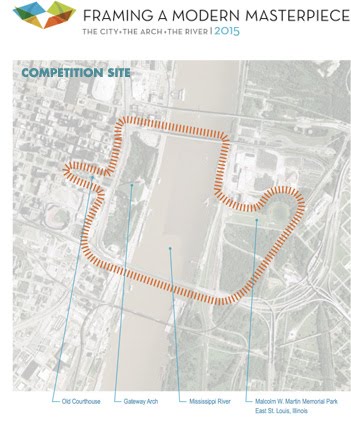
The City + Arch + River design competition is intended to overcome the island effect and reconnect the Arch and riverfront to the city. Restablishing connectivity is the common theme of the new Jefferson National Expansion Memorial General Management Plan and the Arch design competition.
What we don't want to see happen is an expansion of the federal island. If the competition program is about reweaving connections between the riverfront, downtown, and the Arch, then the boundaries of the competition are where the design is most important.
If the St. Louis Art Museum, History Museum, and Science Center were all moved to the Arch grounds, would that increase visits to downtown? The Jefferson National Expansion Museum already has two museums, one under the Arch and one in the Old Court House. But if you ask visitors to the Arch, what drew them to the site, would they tell you it was the Arch or the museums? Most would say it was the Arch. "There's nothing wrong with the Arch; there's nothing wrong with the Arch".
Would a restaurant on the grounds of the Statue of Liberty draw more visitors to the Statue of Liberty? Would a museum alongside the Eifel Tower draw more visitors to the Eifel Tower? Like these two iconic landmarks, people come to see the icon.
Another goal of the design compeition is to catalyze the Arch grounds as a way to enliven downtown. Hence, downtown should be the destination for services, not the landmark. Looking at the possible downside, if there were a new restaurant or other services offered on the Arch grounds, they might siphon off customers who would otherwise patronize downtown restaurants and local businesses.
How do new attractions on the Arch grounds or the East St. Louis riverfront improve the connection between the riverfront, downtown and the Arch grounds? It is hard to see how they do.
If reestablishing connectivity is the biggest goal of the design competition, then the number one goal of the program should be to solve the connection problem and secure funding to make it happen before planning new attractions.
What St. Louis does not need is a nicer island in the heart of downtown. What people are calling for is a City that is reconnected to the River.
Friday, June 25, 2010
Friday rewind
Summer is Farmer's Market season in St. Louis, and downtown is in on the action:

Washington Avenue gets lots of attention and is home to cool places on every block, but Olive Street has a real urban canyon feel too, and is seeing a big increases in pedestrian traffic:

I vote for Olive to be the place to host downtown's next parade. Narrow city streets make the best parade venues.

Washington Avenue gets lots of attention and is home to cool places on every block, but Olive Street has a real urban canyon feel too, and is seeing a big increases in pedestrian traffic:

I vote for Olive to be the place to host downtown's next parade. Narrow city streets make the best parade venues.
Ecology of Absence has moved
It is now part of Michael Allen's Preservation Research Office website. Links have been updated.
Wednesday, June 23, 2010
A sustainable future for the Mississippi watershed?
That's what river interests are considering this week in St. Louis. The timing of their meeting could not be better as it comes just before the second round of mid- course reviews for the teams competing in the Arch design competition.
Early plans to reinvigorate the downtown St. Louis riverfront included such ideas as manmade, floating islands. But those were ruled out due to the frequent flooding and fast currents of the river at St. Louis.
The Mississippi watershed is one of the largest in the world, and having its future planned in St. Louis is a great opportunity. Weaving these efforts together with the future of the Arch grounds provides further opportunities for connecting St. Louis with its historic riverfront, creating sustainable futures for the river and the riverfront.
There is more reading to do. What defines a "sustainable watershed"? With all the water the Mississippi River carries, what distinguishes it from being a sustainable or non-sustainable watershed? The answer probably has something to do with such things as flood plains, flooding, dams, river travel, and farmlands...
Early plans to reinvigorate the downtown St. Louis riverfront included such ideas as manmade, floating islands. But those were ruled out due to the frequent flooding and fast currents of the river at St. Louis.
The Mississippi watershed is one of the largest in the world, and having its future planned in St. Louis is a great opportunity. Weaving these efforts together with the future of the Arch grounds provides further opportunities for connecting St. Louis with its historic riverfront, creating sustainable futures for the river and the riverfront.
There is more reading to do. What defines a "sustainable watershed"? With all the water the Mississippi River carries, what distinguishes it from being a sustainable or non-sustainable watershed? The answer probably has something to do with such things as flood plains, flooding, dams, river travel, and farmlands...
Wednesday, June 16, 2010
Trust for Public Land covers City to River, DOT shared interests...
Is the City to River downtown St. Louis boulevard plan aligned with new US Department of Transportation urban infrastructure strategies?
The boulevard can brighten your day!

Does driving the depressed lanes or on the top of an elevated highway lift your spirits? Does the experience improve your daily routine? Does it make you happy?
What about driving through Forest Park? Do you ever plan your trips through the park when connecting between Point A and Point B? I know I do. There are lots of ways to go, but the beauty of the drive through the park makes for a better day. I like seeing the green of the park rather than the grey of concrete.
Do you think a landscaped boulevard, possibly with a fountain or two, and views of the Eads Bridge, the Arch and Old Court House might have the same effect? Would it be a nicer way to make your way through town than on a buried highway or elevated interstate?
Tuesday, June 15, 2010
What he said...
Guest PD Columnist, Brad Fratello, writes about the proposed downtown boulevard plan:
City to River says lose "The Lid", back "The Boulevard"
The print edition has four color before and after photos. Pick up a copy to share with friends!
City to River says lose "The Lid", back "The Boulevard"
The print edition has four color before and after photos. Pick up a copy to share with friends!
Monday, June 14, 2010
Arch boulevard to catalyze $1.2 billion in new downtown investments?
City to River cites Development Strategies statistics on the development potential created by a new boulevard next to the Arch.
Post Dispatch reports on the possibility of a new Memorial Drive.
Lots of updates and questions answered at the City to River website...
For those wondering about the development of downtown, remember that over the last ten years, downtown growth has exceeded by many multiples goals as set forth in the Downtown Now plan.
The formula calls for a public/private partnership whereby updated infrastructure brings about economic growth. We have done it before and we can do it again.
Post Dispatch reports on the possibility of a new Memorial Drive.
Lots of updates and questions answered at the City to River website...
For those wondering about the development of downtown, remember that over the last ten years, downtown growth has exceeded by many multiples goals as set forth in the Downtown Now plan.
The formula calls for a public/private partnership whereby updated infrastructure brings about economic growth. We have done it before and we can do it again.
Friday, June 11, 2010
Thursday, June 10, 2010
Active streets in downtown - what works?

The view above is taken around 5:15 pm from northbound 7th Street about two hours before game time. Over the next two hours, cars and pedestrians crowd the streets and sidewalks in front of Busch Stadium.
Around the corner, on the south side of Busch, there is the elevated structure of Interstate 64. It casts a shadow over the area, creates a foreboding presence, and there are few pedestrians and little streetlife. The condition is not unlike the area along the riverfront, Laclede's Landing, and the Arch grounds created by the presence of Interstate 70.
The boulevard plan proposed by City to River creates a connection between activity generators (the Arch, riverfront, and downtown neighborhoods) encouraging street life. Currently, the area instead is dominated by the presence of an interstate, which acts to deaden the area and discourage street life, just as we see along the south side of Busch Stadium.
The riverfront, Arch grounds, and downtown neighborhoods are already good activity generators or "assets". But generally, all of these areas have minimal street life, especially around the Arch and riverfront. So, the question is, which draws street life, good streets or activity generators?
City to River has created a "What You Can Do" page at the City to River website. If you want to see a pedestrian friendly boulevard in place of the soon-to-be-former downtown lanes of Interstate 70, consider taking these steps in support of the City to River effort.
Tuesday, June 01, 2010
Iron Barley Rib Fest
Down on Virginia at Bates, Iron Barley owners Jenn and Tom Coghill hosted their annual Memorial Day Rib Fest and fundraiser. A block of Virginia was closed for the food booths, beverage stands, and music stage.

This year's event raised funds for the USO and Fisher House, a veteran's service home offering family members of wounded veterans a place to stay while their loved ones undergo medical care.
Here's Fred Friction, booking agent for Iron Barley, celebrating with one of the winning barbeque contestants.

And here are Jenn and Tom awarding one of the Rib Fest trophies.

With the Rib Fest a wrap, Iron Barley devotees will have to wait a couple of weeks while the staff gets a much deserved break and the restaurant goes through some inside updates.
When the restaurant reopens, be sure to visit for some of the best food in all of St. Louis.

This year's event raised funds for the USO and Fisher House, a veteran's service home offering family members of wounded veterans a place to stay while their loved ones undergo medical care.
Here's Fred Friction, booking agent for Iron Barley, celebrating with one of the winning barbeque contestants.

And here are Jenn and Tom awarding one of the Rib Fest trophies.

With the Rib Fest a wrap, Iron Barley devotees will have to wait a couple of weeks while the staff gets a much deserved break and the restaurant goes through some inside updates.
When the restaurant reopens, be sure to visit for some of the best food in all of St. Louis.
Friday, May 28, 2010
Danforth Said it Best
Back in the days of St. Louis 2004, Senator John Danforth said it best when he proclaimed "St. Louis is not a spectator sport". His point was that everyday people need to get personally involved in the effort to improve St. Louis.
Reading blogs and watching television is not enough. Knowing what's best isn't enough. People have to get off the sidelines and do things. Now is one of those key times when regular, everyday people can make a difference in the future of our city.
There is a push on in our community right now to have an impact on the future of downtown St. Louis and the riverfront. If you are a regular visitor of this site, you know what it is: City to River is working to remove the downtown lanes of I-70that have been the physical and psychological barrier dividing downtown from the Arch grounds and riverfront.
Now is the time and this your opportunity to help make it happen. Click here to find out how.
Reading blogs and watching television is not enough. Knowing what's best isn't enough. People have to get off the sidelines and do things. Now is one of those key times when regular, everyday people can make a difference in the future of our city.
There is a push on in our community right now to have an impact on the future of downtown St. Louis and the riverfront. If you are a regular visitor of this site, you know what it is: City to River is working to remove the downtown lanes of I-70that have been the physical and psychological barrier dividing downtown from the Arch grounds and riverfront.
Now is the time and this your opportunity to help make it happen. Click here to find out how.
Wednesday, May 26, 2010
Windshield Survey (with frequent updates)

One of the top concerns regarding converting the soon-to-be-former downtown lanes of I-70 into a new at-grade boulevard is how to handle the truck traffic.
With the rerouting of I-70 north of downtown over the new Mississippi River bridge, all of the east and west bound I-70 through truck traffic currently using the depressed lanes and Poplar Street Bridge will be diverted away from downtown over the new bridge.
However, to get an idea of the volume of truck traffic through the area today, this week I started doing my own survey. I've been counting oversized vehicle traffic along the depressed lanes continuing south on I-55 toward South County.

To date, I've completed three counts. When counting I count all oversized vehicles coming in the opposite direction, plus all the oversized vehicles travelling in front of me and behind me as far as I can see in my direction. The counts are being taken during morning rush hour.
The first count was on northbound 55 between Gasconade and exiting Memorial Drive at around 7:15 am (about 3.5 miles). Total oversized vehicle traffic: 41 vehicles
The second count was taken from Memorial Drive through southbound 55 to the Germania exit (about 6.5 miles) at around 8:15 am: Total oversized vehicle traffic: 59 vehicles
The third count was taken on northbound 55 from River des Peres through to the Memorial Drive exit at about 8:50 am: Total oversized vehicle traffic: 61 vehicles.
We are counting school buses and UPS sized panel trucks, but not pickup-styled small contractor trucks.
School buses and panel vans comprise about 1/2 the total oversized vehicle counts. Full size over the road tractor trailers comprise about the other 50%.
Compared to total vehicle traffic, oversized vehicles appear to take up less than 10 percent of all traffic through the area. Truck traffic is present, but does not appear to be an overly high percentage of overall traffic volume.
UPDATE - Thursday, May 27
Counting cars at 6:36 am on northbound I-55 from River Des Peres to the Memorial Drive exit, there were a total of 63 oversized vehicles, with approximately half of them school buses. So many school buses on the highway in the morning makes you wonder if all those buses are carrying kids headed toward St. Louis County as part of the deseg program?
Monday, May 24, 2010
One More Bridge to Go?

Friday's celebration surrounding the demolition of the St. Louis Centre skybridge over Washington Avenue clears the way for one more step towards the revitalization of downtown St. Louis. The removal of the skybridge creates an uninterrupted streetscape view down Washington Avenue - to the west.
The view above is what will be revealed looking east - the nearly fifty-year old elevated lanes of I-70 above Memorial Drive. Just beyond the elevated lanes are the Eads Bridge, the Mississippi River, the Arch grounds, Laclede's Landing and a Metrolink station.
Imagine in place of the elevated lanes a new, at-grade, pedestrian friendly boulevard. An at grade boulevard in place of the elevated lanes creates clear views east and west along Washington Avenue.
The all-volunteer citizens group City to River is proposing just that, with the goal of seeing teams competing in the Arch design competition propose highway removal as part of their design solutions to reconnect the city to the riverfront and Arch grounds.
For more information on City to River's efforts to replace the soon-to-be-former elevated and depressed lanes of I-70 through downtown with a new urban boulevard, visit the City to River website or contact info@citytoriver.org.
Tuesday, May 18, 2010
Old time St. Louis alive and well
This post isn't so much about St. Louis rising as it is about St. Louis at its best.
Epiphany Church on Ivanhoe is one of the city's many Catholic parishes.

Epiphany has its own bowling alley and a few years ago the parish installed mechanized pin setters to take the place of the old hand setters.

In 2010, the church is launching a blog. You can visit the site here: Ephipany blog. Epiphany's new website contains much more information than is usually found in blogs.
The site contains plentiful information about the church and parish, and even includes one of those elusive parish boundary maps, along with a legal description of the parish boundary. In a city known for having many overlapping boundaries and districts, some of the most interesting of all are the boundaries of Catholic parishes.
Ivanhoe is one of those classic historic streets in St. Louis. Within walking distance of the church, you find lots of gems. One of those is Pizza A Go Go. The pizza is some of the best in town. Pizza A Go Go has excellent pizza but is also known for some quirky rules.
Pizza A Go Go's website is actually a blog. The comments there are a testament to the quality of the pizza, but be sure to also read the strict enforcement of the house rules for ordering pizza. Pizza A Go Go does not sell beer, but customers have been known to bring their own, keeping it chilled in the cooler located in the small dining room. If you think the building is an old service station, you are probably right.

Across from Pizza A Go Go is Killer Vintage. Killer Vintage specializes in vintage musical instruments and amplifiers. The store has one of the finest collections in the midwest.

With so much diversity at a walkable scale, old neighborhoods are cool and interesting places. They have lots of unique small businesses, historic homes, bowling alleys, and churches. A mile or so west of Ivanhoe is Sutton in Maplewood. Sutton competes with Ivanhoe for being one of the nicest neighborhood settings in St. Louis. Along Sutton, some of the historic homes are finding new uses as professional offices.

And there are also cool churches, including the one shown below, ornamented with tons of terra cotta. I have not seen the inside of this one, but according to local legend, the interior of this church served as one of the sets for George Clooney's recent "Up In the Air" film.

With so much going for it, Sutton also boasts what is possibly the coolest bowling alley in St. Louis, the Saratoga Lanes, located on the second floor of this building:

If you buy an old guitar at Killer Vintage, you will need a place to have it repaired, and Goez Stringed Instrument shop is a place to go. They're located in this building, also on Sutton:

And when you have that vintage instrument sounding its best, there are a number of fine venues along Sutton for performance, one of the best being the Focal Point:

The St. Louis area is blessed to have many areas like the very walkable Sutton and Ivanhoe neighborhood districts. They offer charm and a sense of place that increase the quality of our lives. If you're looking for an interesting place to do some shopping, spend a leisurely afternoon or evening, or find a new home, check out these places and our other friendly neighborhood choices.
Epiphany Church on Ivanhoe is one of the city's many Catholic parishes.

Epiphany has its own bowling alley and a few years ago the parish installed mechanized pin setters to take the place of the old hand setters.

In 2010, the church is launching a blog. You can visit the site here: Ephipany blog. Epiphany's new website contains much more information than is usually found in blogs.
The site contains plentiful information about the church and parish, and even includes one of those elusive parish boundary maps, along with a legal description of the parish boundary. In a city known for having many overlapping boundaries and districts, some of the most interesting of all are the boundaries of Catholic parishes.
Ivanhoe is one of those classic historic streets in St. Louis. Within walking distance of the church, you find lots of gems. One of those is Pizza A Go Go. The pizza is some of the best in town. Pizza A Go Go has excellent pizza but is also known for some quirky rules.
Pizza A Go Go's website is actually a blog. The comments there are a testament to the quality of the pizza, but be sure to also read the strict enforcement of the house rules for ordering pizza. Pizza A Go Go does not sell beer, but customers have been known to bring their own, keeping it chilled in the cooler located in the small dining room. If you think the building is an old service station, you are probably right.

Across from Pizza A Go Go is Killer Vintage. Killer Vintage specializes in vintage musical instruments and amplifiers. The store has one of the finest collections in the midwest.

With so much diversity at a walkable scale, old neighborhoods are cool and interesting places. They have lots of unique small businesses, historic homes, bowling alleys, and churches. A mile or so west of Ivanhoe is Sutton in Maplewood. Sutton competes with Ivanhoe for being one of the nicest neighborhood settings in St. Louis. Along Sutton, some of the historic homes are finding new uses as professional offices.

And there are also cool churches, including the one shown below, ornamented with tons of terra cotta. I have not seen the inside of this one, but according to local legend, the interior of this church served as one of the sets for George Clooney's recent "Up In the Air" film.

With so much going for it, Sutton also boasts what is possibly the coolest bowling alley in St. Louis, the Saratoga Lanes, located on the second floor of this building:

If you buy an old guitar at Killer Vintage, you will need a place to have it repaired, and Goez Stringed Instrument shop is a place to go. They're located in this building, also on Sutton:

And when you have that vintage instrument sounding its best, there are a number of fine venues along Sutton for performance, one of the best being the Focal Point:

The St. Louis area is blessed to have many areas like the very walkable Sutton and Ivanhoe neighborhood districts. They offer charm and a sense of place that increase the quality of our lives. If you're looking for an interesting place to do some shopping, spend a leisurely afternoon or evening, or find a new home, check out these places and our other friendly neighborhood choices.
Thursday, May 13, 2010
People on the street?
One of the goals urban planners have to revitalize downtown areas is to get more people on the street - more pedestrian activity. St. Louis is often criticized for lacking pedestrian activity and having no street life. So I was trying to think where in our downtown are there throngs of people on the sidewalks, right alongside busy vehicular traffic? Anywhere?

Yes! Right outside new Busch Stadium!
At the same time downtown office buildings are emptying out and workers are headed to their cars, thousands of baseball game visitors are walking to Busch Stadium. The combination of these two events creates a heavy amount of pedestrian and vehicular traffic on the east and west sides of Busch Stadium.
It works. Before every ballgame there are street musicians, traffic cops on foot and in golf carts, lots and lots of people, sidewalk vendors, and happy people and urban vibrancy.
So then if we apply what we've learned with the new ballpark to the ongoing Arch design competition, why not repeat this success and create a new pedestrian friendly boulevard alongside the Arch grounds, one that reconnects St. Louis to the riverfront?
They say Missouri is the "Show Me State". At Busch Stadium we have proof that cars and people can mix, and create a vibrant street. Let's build on that success and extend an active downtown street grid to the riverfront!

Yes! Right outside new Busch Stadium!
At the same time downtown office buildings are emptying out and workers are headed to their cars, thousands of baseball game visitors are walking to Busch Stadium. The combination of these two events creates a heavy amount of pedestrian and vehicular traffic on the east and west sides of Busch Stadium.
It works. Before every ballgame there are street musicians, traffic cops on foot and in golf carts, lots and lots of people, sidewalk vendors, and happy people and urban vibrancy.
So then if we apply what we've learned with the new ballpark to the ongoing Arch design competition, why not repeat this success and create a new pedestrian friendly boulevard alongside the Arch grounds, one that reconnects St. Louis to the riverfront?
They say Missouri is the "Show Me State". At Busch Stadium we have proof that cars and people can mix, and create a vibrant street. Let's build on that success and extend an active downtown street grid to the riverfront!
More of these please!

One of the best things about walkable neighborhoods is the way they open up possibilites beyond the front walk. Here is an example of a courtyard patio located in the back area of a popular restaurant. You access the courtyard either through the main building or via a gated entrance on the side street.
This patio features beautiful flowers and plants, terraces, cast iron tables and chairs, fish ponds, an iron fountain, multiple bar areas, a huge, shady covered section, lots of nice brick, and a full service food and bar menu.
Sidewalk cafes are great, but interior courtyards are my favorite. They bring a little bit of New Orleans to St. Louis. They are hidden jewels inside cool neighborhoods. There aren't very many in St. Louis. I can't think of one in the Central West End or Lafayette Square neighborhoods. The one pictured here is in Soulard. Are there others?
Subscribe to:
Posts (Atom)