Support is growing for City to River's vision for removing the downtown lanes of I-70 between the riverfront and downtown after the opening of the new I-70 bridge.
The challenge of solving logistics is high on the priority list of planning this project. How would you like to see construction of the new boulevard phased? Here are some ideas.
Opening of the new I-70 bridge is scheduled for 2014. With the slow economy, it's possible the project will be completed ahead of schedule.
Starting in the Fall of 2010, planning and engineering for the new boulevard and highway removal begins. City to River works to engage interested parties in keeping project on track.
Upon opening of the new bridge, close the former I-70 downtown elevated lanes between the new I-70 bridge and the Poplar Street Bridge. I-55 traffic is directed onto Memorial Drive or across Poplar Street Bridge. I-70 traffic is rerouted across the new bridge or onto city surface streets.
Demolish the old elevated lanes and grind the rubble for clean fill. Recycle structural steel from the elevated lanes. According to engineered plans, begin process of filling in the depressed lanes. Bring the void of the depressed lanes up to grade. During this time, Memorial Drive remains open.
Once depressed lanes are brought to grade, demolish the transition between the old walls of the trench and Memorial Drive. According to engineered plans, compact the entire area creating the roadbed for construction of the lanes of the new Memorial Drive, on-street parking, and landscape medians and other amenities.
Schedule all work to be completed within one year of completion of opening of the new I-70 bridge. With this schedule, the new boulevard is open nearly on the same schedule as the new improvements to the Arch grounds.
Thursday, August 19, 2010


Wednesday, August 18, 2010
Arch Design Competition Public Comment Window Open
Competition comment period open this week. To celebrate the ongoing effort, City to River is hosting a community event tonight at the Schlafly Tap Room
Yesterday, five exciting visions were revealed that point toward a bright future for the Arch Grounds and downtown St. Louis.
The proposals unveiled make clear that the teams agree with City to River’s supporters that highway removal is the ultimate solution to fully reconnecting the city with the Arch and riverfront.
From four of the five finalist teams:
“City to River articulates an enormous number of benefits arising from such a scheme…”
- SOM Team
“..the benefits of removing the highway altogether are clear...”
- MVVA Team
“Full Circle’s grand loop of transportation facilities could be easily integrated into its [City to River’s] design."
-Weiss-Manfredi Team
"We predict fanfare should the elevated highway that cuts off Laclede’s Landing be removed."
- The Behnisch Team
Come to the Schlafly Tap Room Club Room tonight (7:30 p.m., 2100 Locust Street) to show your support for highway removal! Have your voice heard on this pivotal regional issue. The event is FREE.
Yesterday, five exciting visions were revealed that point toward a bright future for the Arch Grounds and downtown St. Louis.
The proposals unveiled make clear that the teams agree with City to River’s supporters that highway removal is the ultimate solution to fully reconnecting the city with the Arch and riverfront.
From four of the five finalist teams:
“City to River articulates an enormous number of benefits arising from such a scheme…”
- SOM Team
“..the benefits of removing the highway altogether are clear...”
- MVVA Team
“Full Circle’s grand loop of transportation facilities could be easily integrated into its [City to River’s] design."
-Weiss-Manfredi Team
"We predict fanfare should the elevated highway that cuts off Laclede’s Landing be removed."
- The Behnisch Team
Come to the Schlafly Tap Room Club Room tonight (7:30 p.m., 2100 Locust Street) to show your support for highway removal! Have your voice heard on this pivotal regional issue. The event is FREE.
Monday, August 16, 2010
Invasion from the north

Saturday night the Minnesota Vikings paid a visit to St. Louis. They played the St. Louis Rams in the first pre-season game of the 2010 season. The Vikings won the game handily, giving rookie Rams QB Sam Bradford a dose of NFL medicine. With the holes in the Rams offensive line, this might be a long season for Bradford and the Rams. But the real question is whether the Rams are long for St. Louis? Can St. Louis compete in the NFL game?
The Rams are for sale and the top bidder is minority owner Stan Kroenke. Kroenke has been cagey in his responses about his commitment to keep the team in St. Louis. Meanwhile, in 2014, the Rams have an escape clause in their lease for the Edward Jones Dome. If the Dome is not considered in the upper eschelon of NFL stadiums, the Rams are free to move. A lot has to happen in order to meet that requirement.
For this pre-season matchup, the Rams played in a stadium that was only about 70% filled. Of those in attendance, a large number had driven down from Minnesota to watch the game. Given the lack of a sellout, the game was not broadcast live in St. Louis. Last year, many regular season Rams games did not sell out, preventing the game from live television broadcast in St. Louis. Low attendance at games combined with a lack of local live broadcasts feeds on itself in a downward spiral of dwindling fan interest.
Meanwhile, out in LA, plans are in the works and financing is coming together for a brand new $1 billion dollar football mecca, replete with all the luxuries desired to put LA on the dance card to be a regular Super Bowl host city. Can St. Louis compete with that? Not likely.
St. Louis is a metro of 2.5 million. The greater LA area has 15 million. Whether for filling the stadium with fans or setting ad rates for televised games, LA has huge market demand to offer the new Rams ownership.
LA is the sentimental hometown of the Rams. The playing years of many of their Hall of Fame legends are based in LA. The Warner, Bruce, Holt years in St. Louis made great history. But with the soon to be voided stadium lease in St. Louis and tempting conditions shaping up in LA, does St. Louis have a prayer in keeping the Rams? If we lose the team to another market, will St. Louis ever be home city to an NFL team again?
Sunday, August 15, 2010
Friday, August 13, 2010
Illinois Gems

Illinois is a state filled with rare treasures. The small towns and farms, and beautiful court houses hold many wonderful surprises.
Adorning a small conference room in a central Illinois municipal office, is a work of art completed as part of the Public Works of Art Project, also known as the Federal Art Project.
It's interesting to note that over 70 years ago, at a time of economic stress, the federal government intervened not only in providing public works projects but also public art projects.
The work pictured above was completed in 1934. A brass plaque at the bottom of the frame reads, "Public Works of Art". The painting is signed "John Stephen 34". I wonder what the subject is? The mood is an awesome reflection of the times.
Beers for a Boulevard

No, we're not talking about Boulevard Ale, it's City to River along with STL Style sponsoring an event at the headquarters of St. Louis' largest locally owned brewer, Schlafly, to celebrate the culmination of the Arch design competition.
Join friends and neighbors for a fun evening in a beautiful setting in support of efforts to reconnect the City, the Arch and the River. For more information, check out the Facebook invitation here:
Facebook Invite
Wednesday, August 11, 2010
Riverfront, Arch poised to be downtown's next hot spot?
Washington Avenue led the way through the late 90s and early - mid 2000s. Will the riverfront area and Arch grounds be the center of excitement for the next big wave of downtown renewal?
Check out the list of downtown stakeholders supporting City to River's proposal to open up the downtown/riverfront area through highway removal and creation of a new Memorial Drive:
City to River releases it's expanded list of supporters
Check out the list of downtown stakeholders supporting City to River's proposal to open up the downtown/riverfront area through highway removal and creation of a new Memorial Drive:
City to River releases it's expanded list of supporters
Tuesday, August 10, 2010
"Gateway to a new legacy"
That's the title of a recent City to River blog entry. The Arch design competition is reaching its final stage.
Soon the five finalist design teams will unveil their proposals and St. Louis will face a decision that will redefine her downtown and the region for the next fifty to one hundred years.
Much has been written about the planning mistakes of the past. Actions now will lay new foundations for our future. Not since the passing of the riverboat era has St. Louis had such importance placed on its riverfront.
The projected budget for the total program (low estimate, for Missouri and Illinois) is over $300,000,000. When it was first built (1960s dollars) the cost of the Arch was about $13 million.
Will you work to make dreams reality? We are on a community odyssey setting course for a new future. Will hope and vision prevail over cynicism and naysaying?
It's up to each of us to make a difference. We can do this. Let's watch and work for great things.
Soon the five finalist design teams will unveil their proposals and St. Louis will face a decision that will redefine her downtown and the region for the next fifty to one hundred years.
Much has been written about the planning mistakes of the past. Actions now will lay new foundations for our future. Not since the passing of the riverboat era has St. Louis had such importance placed on its riverfront.
The projected budget for the total program (low estimate, for Missouri and Illinois) is over $300,000,000. When it was first built (1960s dollars) the cost of the Arch was about $13 million.
Will you work to make dreams reality? We are on a community odyssey setting course for a new future. Will hope and vision prevail over cynicism and naysaying?
It's up to each of us to make a difference. We can do this. Let's watch and work for great things.
Thursday, August 05, 2010
Outpouring of support for highway removal at Arch design competition website
From the City + Arch + River Design Competition website "Community Connections" page, there is a huge outpouring of support for City to River's vision of removing the highway between the Arch and downtown and replacing it with an at-grade, urban boulevard. Below is a sample of the comments. Click on the highlighted text to read them all and add your own.
"I support removing the section of I-70 between Cass Ave and Poplar Street and replacing it with a boulevard. I support the City to River plan. www.citytoriver.org"
- Jill M.
“I would like to voice my support of City to River’s concept of removing Interstate 70 from the Poplar Street Bridge to Cass Avenue and replacing it with a pedestrian-friendly boulevard. I believe that a new Memorial Drive would reopen the front door for St. Louis and connect the city, the Arch and the river more completely. As citizens of Saint Louis, we have an unique opportunity to revitalize our Mississippi riverfront during the renovation of the Jefferson National Expansion Memorial and the construction of the new Mississippi river bridge. Let us use this opportunity to create a more vital connection with our city’s grand lifestream. Please incorporate this concept into your design! ”
- Mark C
"I grew up in St. Louis and am among those that have always considered the I-70 crossing through downtown as a near fatal gash through the heart of the city. For a city that boasts a history with the river, we have isolated ourselves and our downtown from that source of so much rich history. This is an opportunity that I did not think would come in my life time; the chance to remove the highway from blocking access to the river, and the Arch, from downtown. I implore the designers to incorporate a new Memorial Drive and removal of I-70 from downtown as part of rejuvenating St. Louis and giving us back our river. Without direct access to the Arch and the River, I’m sorry but we are not a river city and should refrain from calling ourselves as such. Thank you for the chance to voice my opinion."
- Dennis N
"I like this plan and since I moved here 9 years ago I have wondered why it hasn’t already been done."
- James W
"I support removing the section of I-70 between Cass Ave and Poplar Street and replacing it with a boulevard. I support the City to River plan. www.citytoriver.org"
- Jill M.
“I would like to voice my support of City to River’s concept of removing Interstate 70 from the Poplar Street Bridge to Cass Avenue and replacing it with a pedestrian-friendly boulevard. I believe that a new Memorial Drive would reopen the front door for St. Louis and connect the city, the Arch and the river more completely. As citizens of Saint Louis, we have an unique opportunity to revitalize our Mississippi riverfront during the renovation of the Jefferson National Expansion Memorial and the construction of the new Mississippi river bridge. Let us use this opportunity to create a more vital connection with our city’s grand lifestream. Please incorporate this concept into your design! ”
- Mark C
"I grew up in St. Louis and am among those that have always considered the I-70 crossing through downtown as a near fatal gash through the heart of the city. For a city that boasts a history with the river, we have isolated ourselves and our downtown from that source of so much rich history. This is an opportunity that I did not think would come in my life time; the chance to remove the highway from blocking access to the river, and the Arch, from downtown. I implore the designers to incorporate a new Memorial Drive and removal of I-70 from downtown as part of rejuvenating St. Louis and giving us back our river. Without direct access to the Arch and the River, I’m sorry but we are not a river city and should refrain from calling ourselves as such. Thank you for the chance to voice my opinion."
- Dennis N
"I like this plan and since I moved here 9 years ago I have wondered why it hasn’t already been done."
- James W
Thursday, July 29, 2010
Go Dog, Go!
The growing numbers of scooters on the streets of downtown is a telling sign of downtown's continuing rebirth. Scooters are cool, and their riders make downtown feel more alive.
Just the other day, though, I saw a strange sight. A businessman riding a high powered, fast scooter, was racing down Olive. That was cool, but he was also running red light after red light. Hey, keep up that pace, and you'll run head long into the river! Well, okay, he'd be blocked by the depressed lanes of I-70...
Now sure, it's common to see bicyclists run red lights, and pedestrians walking against a light or jaywalking, but motorized scooters? Dude! You're taking things too far!
Okay, so I suppose there's a sense of anarchy and coolness associated with scooters. They're a rebel ride. But blowing red lights around the Old Post Office? Is that cool?
Granted, there are some blocks in the city and even one way streets, where there are so few cars - or people - or even houses - that the writer of this blog has been known to take some "liberties". It's sort of one of those tree falling in the forest things - would anyone even know?
But in the heart of downtown, dressed in a suit and tie, in the middle of the morning-arrive-to-work-hour? We are a real city after all, and there have to be some rules, right?
Maybe we need cops on scooters!
Just the other day, though, I saw a strange sight. A businessman riding a high powered, fast scooter, was racing down Olive. That was cool, but he was also running red light after red light. Hey, keep up that pace, and you'll run head long into the river! Well, okay, he'd be blocked by the depressed lanes of I-70...
Now sure, it's common to see bicyclists run red lights, and pedestrians walking against a light or jaywalking, but motorized scooters? Dude! You're taking things too far!
Okay, so I suppose there's a sense of anarchy and coolness associated with scooters. They're a rebel ride. But blowing red lights around the Old Post Office? Is that cool?
Granted, there are some blocks in the city and even one way streets, where there are so few cars - or people - or even houses - that the writer of this blog has been known to take some "liberties". It's sort of one of those tree falling in the forest things - would anyone even know?
But in the heart of downtown, dressed in a suit and tie, in the middle of the morning-arrive-to-work-hour? We are a real city after all, and there have to be some rules, right?
Maybe we need cops on scooters!
Wednesday, July 28, 2010
"This block under 24 hour video surveillance"

At STL Rising, we trail far behind the trends in new technology. The rest of the world is far ahead of us. In fact, most people reading this site probably own smart phones and flat screen TVs. So, in these times of expanding technology in our daily lives, today we raise the subject of neighborhood watch using low cost digital video surveillance.
Common complaints heard on the neighborhood watch scene are car cloutings and garage break-ins. Technology exists to easily and at minimal cost set up hidden digital video cameras around your neighborhood.
Software triggers the camera to operate based on motion. If there is movement in the pixels, the camera starts shooting. Sensitivity is adjustable so that a falling leaf or chasing squirrel doesn't trigger the camera, but something larger, like a person on foot does.
These systems are becoming more common on private property. Owners can install these systems in the fronts of their homes, back yards, or in alleys. Multiple owners can create networks to cover entire blocks. Big brother watching you? Maybe.
Yet, if you're a would be car clouter, drug dealer, garage thief or grafitti tagger, and you see a sign at the entrance to a neighborhood street announcing the presence of 24 hour digital surveillance, are you less likely to attempt a crime on the block? And if a crime occurs, and the act is caught via digital recorder, does law enforcement have a way to apprehend criminals?
Would you want to expand systems like these in your neighborhood? Should we push for these in areas of increased criminal activity? Is a future with expanded video surveillance likely for St. Louis? Is there a downside?
Tuesday, July 27, 2010
Friday, July 23, 2010
Freeway Jam

"Freeway" is a word I grew up with. Living in California, people say "freeway". Freeways are supposed to zip you from point A to point B, with little thought of what happens in between.
It's not about the journey; it's about the destination. Unfortunately, you don't always zip. You often sit. And in California, most of the time, there are no alternatives for the freeway. So you can sit a looong time.
This week, drivers in St. Louis got a taste of what it's like to get stuck on a freeway. Bad weather caused accidents and flooding, stranding drivers on local "freeways" for hours.
Downtown is no different. There are times when cars are stacked up on the freeways around downtown. For these drivers, just like in California, it's not about the journey, it's about the destination. And sitting in a traffic jam is no fun when you're trying to get somewhere.
All of this talk of freeway jams brings us to the final stage of the Arch design competition. If one of the main goals of the competition is to weave connections, then what should we expect from the design teams?
Is it possible that some of the teams are thinking that those connections mean improved highway access to the Arch? More freeway connections? More on and off ramps to serve the Arch grounds?
Are designers envisioning access to the Arch for drivers more interested in the destination than the journey? Do those visitors want an unimpeded freeway connection straight from the freeway into the Arch garage? Are we encouraging an experience for them that begins and ends at the Arch?
Or do we want to create an experience where people enter our city and then arrive at the Arch and the riverfront at the heart of it all? What do connections like that look like? We will soon see. Or will we?
Is it possible that the teams will punt on the connectivity issue, and focus instead on proposing more attractions for the Arch grounds?
In a competition that promotes the goal of reweaving connections, this is our one big chance to make bold plans. Plans that restore the natural connections between downtown, the Arch, and the riverfront. After all, that's what this process is supposed to be all about.
Support the Old North food coop
The store is well stocked with fresh foods at good prices:

The coop supports local farmers from around St. Louis:

The store is open to the public with no membership required. They are located on St. Louis Avenue, just a block east of the new Crown Square development and Crown Candy Kitchen. Hours are convenient for a stop on your way home before dinner.
It's a neighborhood and community-based project and part of the continuing work to improve St. Louis one step at a time.

The coop supports local farmers from around St. Louis:

The store is open to the public with no membership required. They are located on St. Louis Avenue, just a block east of the new Crown Square development and Crown Candy Kitchen. Hours are convenient for a stop on your way home before dinner.
It's a neighborhood and community-based project and part of the continuing work to improve St. Louis one step at a time.
Thursday, July 22, 2010
Tuesday, July 20, 2010
The case for lowering neighborhood speed limits
For years, this website has promoted the organizaton, "Keep Kids Alive, Drive 25". In fact, the creator of this website served as one of the St. Louis area contacts for the program. Keep Kids Alive is a fine program, and STL Rising will continue to serve as a local representative. However, for the city of St. Louis, we believe an even further reduction in speed limits on neighborhood streets is worth a look.
STL Rising proposes reducing the maximum legal speed on neighborhood streets to 18 miles per hour. We propose 18 mph as a universal, city-wide standard for neighborhood streets. If this seems extreme, let's examine some of the thinking behind the idea.
The city of St. Louis is endowed with thousands of miles of streets layed out on a fine urban street grid. When it snows, most neighborhood streets are not plowed. Besides the cost, the reason neighborhood streets are not plowed is that they are too narrow. Snow would be piled over the cars. So instead, drivers must navigate the ruts of snow and ice out of their neighborhood. The consolation of this situation is that no driver is never more than two blocks from a plowed street. This same situation would apply to a program of reduced speed limits.
If speed limits on neighborhood streets were reduced to 18 miles per hour, no driver would be more than two blocks away from a wider, busier, street with speed limits of 25-35 miles per hour. The net result of the change awould be a negligible delay in people's drive times, but a huge increase in neighborhood quality of life.
Slower travelling cars on neighborhood streets means quieter streets. It means safer streets, and it means more peaceful neighborhoods. A universal speed limit would be easy to understand - it applies to all neighborhood streets.
An ordinance could be passed that unless otherwise posted, all streets in the city limits of St. Louis have a maximum allowable speed of 18 miles per hour. This approach makes it possible to avoid the cost of changing posted speed limit signs. If a block wanted to install their own 18 mph speed limit sign, they would have the option of paying for the cost on their block.
St. Louis has a fantastic street grid, great for walking, lined with beautiful matures tree lined streets, and which presents our wonderful historic neighborhoods. Why not take advantage of this natural asset by making our streets even more friendly and safe by lowering speed limits on neighborhood streets to a max of 18 miles per hour?
STL Rising proposes reducing the maximum legal speed on neighborhood streets to 18 miles per hour. We propose 18 mph as a universal, city-wide standard for neighborhood streets. If this seems extreme, let's examine some of the thinking behind the idea.
The city of St. Louis is endowed with thousands of miles of streets layed out on a fine urban street grid. When it snows, most neighborhood streets are not plowed. Besides the cost, the reason neighborhood streets are not plowed is that they are too narrow. Snow would be piled over the cars. So instead, drivers must navigate the ruts of snow and ice out of their neighborhood. The consolation of this situation is that no driver is never more than two blocks from a plowed street. This same situation would apply to a program of reduced speed limits.
If speed limits on neighborhood streets were reduced to 18 miles per hour, no driver would be more than two blocks away from a wider, busier, street with speed limits of 25-35 miles per hour. The net result of the change awould be a negligible delay in people's drive times, but a huge increase in neighborhood quality of life.
Slower travelling cars on neighborhood streets means quieter streets. It means safer streets, and it means more peaceful neighborhoods. A universal speed limit would be easy to understand - it applies to all neighborhood streets.
An ordinance could be passed that unless otherwise posted, all streets in the city limits of St. Louis have a maximum allowable speed of 18 miles per hour. This approach makes it possible to avoid the cost of changing posted speed limit signs. If a block wanted to install their own 18 mph speed limit sign, they would have the option of paying for the cost on their block.
St. Louis has a fantastic street grid, great for walking, lined with beautiful matures tree lined streets, and which presents our wonderful historic neighborhoods. Why not take advantage of this natural asset by making our streets even more friendly and safe by lowering speed limits on neighborhood streets to a max of 18 miles per hour?
Friday, July 16, 2010
Power Play tonight
My new favorite R and B show band, "Power Play", is performing at CJ Muggs in Webster from 9-1 tonight. If you go, I'll be there wearing the #4, Molina jersey. Stop by to say "hi" and hear some great live music. You will be glad you did!
"St. Louis' downtown 'light years' ahead of other major cities"

Last night we attended a ballgame at Busch Stadium. Over 41,000 fans were there. After the game, around 10:15 pm, fans exiting the stadium flooded the surrounding streets. I wondered how successful new restaurants and bars would be in the area, facing the Metro Station, or lining 7th street on the vacant Ballpark Village site? Sidewalk cafes would be packed on a beautiful night like this. A 7-1 Cards win doesn't hurt either.
Back at the game, next to us at sat two lawyers. One was a recent transplant to St. Louis, having moved here from New York City just eight months ago. Previous to New York, he lived in LA for about eight years. Now, through a job opportunity, he's a downtown STL resident and he couldn't say enough positive things about living downtown.
He bought a loft, which he loves, is twice as big as his New York place, and cost half the price. He describes a lifestyle where he walks to Blues games, walks to his downtown law office, walks to Cardinal games, walks to the grocery store, and even walks to a casino. He walks to City Garden, the library, and soon, he'll be able to walk to a much improved Arch grounds.
Earlier this week, on WGNU radio, two ladies visiting St. Louis for a convention of a womens' sororiety group were being interviewed about their visit here. One was from Chicago, the other Philadelphia. They were both thoroughly enjoying their stay and the one thing they kept repeating was how clean our downtown is. The lady from Philly was really impressed, and was describing how filled with trash Philadelphia's streets are.
So after listening to the show, I took a walk outside to look around. They were right. It's hard to find a single piece of trash lying anywhere around in downtown STL. Someone is paying attention to the little stuff. Part of that effort happens thanks to the work of the Downtown Partnership.
By now, hopefully you've had a chance to listen to Steve Patterson's interview of Downtown Partnership president, Maggie Campbell. Maggie is one of those few people who are a real joy to listen to. She gets into the finer grain of things while keeping things interesting. Anyone who can make overflowing trash cans and dog poop mines on the sidewalk sound like a measure of downtown's growing success is worth an investment of your time.
Halfway through the Campbell interview, Patterson's call drops and Maggie is left wondering if the interview's over. "Hello? Hello?" She waits on the line. After a minute or two, Patterson overcomes the technical problem, and the call continues for the remainder of the hour.
Being techno-challenged, I'm still trying to figure out how that's possible? They're each in separate locations, presumably talking over smart phones. Patterson's call drops; Maggie stays on the line, continuing to be heard over the internet; and then, Patterson gets back on the air, all without missing a beat. Ahh, more technology I will never understand.
Be sure to give the interview a listen. It's hard to think of another venue where you get to hear a full hour of uninterrupted, intelligent discussion with one of our region's top leaders.
Wednesday, July 14, 2010
Sign up for City to River email updates
City to River, the organization promoting the reconnection of the City to the Arch grounds and riverfront by the removal of the downtown lanes of Interstate 70, has created an easy way for members of the general public to support this growing movement.
Through its website, City to River is offering automatic email updates on the highway removal effort. If you are interested in supporting the efforts of City to River, please sign up for email updates at the lower right hand corner of this page.
Through its website, City to River is offering automatic email updates on the highway removal effort. If you are interested in supporting the efforts of City to River, please sign up for email updates at the lower right hand corner of this page.
Excellent interview with President of Partnership for Downtown St. Louis
Maggie Campbell interviewed by Urban Review's Steve Patterson.
Click to hear a great discussion (without commercial interruptions) covering a wide range of topics.
Campbell is impressive with her insights, experience, energy, and vision for improving downtown St. Louis. Patterson shows his interviewing skills.
Click to hear a great discussion (without commercial interruptions) covering a wide range of topics.
Campbell is impressive with her insights, experience, energy, and vision for improving downtown St. Louis. Patterson shows his interviewing skills.
Friday, July 09, 2010
STL Rising is not on twitter...
...so we repost good posts!
Like this (from the website "Gateway Streets"):
Much ado about Interstate 70 traffic
Like this (from the website "Gateway Streets"):
Much ado about Interstate 70 traffic
Cool post from Seoul
The internet brings people together from all around the world. Daron Dierkes, a writer stationed in Seoul, blogs at stlelsewhere with his attention focused on St. Louis.
Mr. Dierkes has some good ideas for how the intersection of Washington Avenue and Memorial Drive might be redesigned. Visit the site and view the concept here:
stlelsewhere on a new plan for the intersection of Washington Avenue and Memorial Drive.
Mr. Dierkes has some good ideas for how the intersection of Washington Avenue and Memorial Drive might be redesigned. Visit the site and view the concept here:
stlelsewhere on a new plan for the intersection of Washington Avenue and Memorial Drive.
Thursday, July 08, 2010
Blowing up things
MODOT is demolishing old bridges over I-70 to make way for the new Mississippi River Bridge.
It's quick work, starting around 7:00 pm on a Friday, and being all wrapped up by 5:00 am Monday morning.
Any idea how much these drop and haul off operations typically cost? What happens to all the rubble and old steel?
It's quick work, starting around 7:00 pm on a Friday, and being all wrapped up by 5:00 am Monday morning.
Any idea how much these drop and haul off operations typically cost? What happens to all the rubble and old steel?
Tuesday, July 06, 2010
Vote for Gateway Greening Today
Gateway Greening is a finalist in a national contest to win a $100,000 grant.
Voting closes tonight at 9:00 PM EST.
Click here for more info and be sure to vote for Gateway Greening:
link to MSNBC contest page
UPDATE:
Everybody wins! Gateway Greening and the two other non-top-prize-winning-finalists each received $50,000 grants for their efforts.
The Bay Area Food Bank won the $100,000 top prize.
Congratulations all around!
Voting closes tonight at 9:00 PM EST.
Click here for more info and be sure to vote for Gateway Greening:
link to MSNBC contest page
UPDATE:
Everybody wins! Gateway Greening and the two other non-top-prize-winning-finalists each received $50,000 grants for their efforts.
The Bay Area Food Bank won the $100,000 top prize.
Congratulations all around!
Is that something?
With the main stage behind them, citizens sit on concrete steps at the riverfront to see something:

In a scene reminiscent of old St. Louis, these citizens are gathered under trees and view something:

With the main stage off in the distance, possibly 300,000 gather to watch something under the Arch:

Meanwhile, just a few blocks away, the streets and alleys of Laclede's Landing are mostly empty:

Yet the people at Laclede's Landing gather to watch something:

Performing in the shadow of the Eads Bridge, in front of a couple hundred people, local R and B group, Power Play, knocks out hit after hit of Motown and soul classics.
Power Play has performed around St. Louis for almost 20 years.

In a scene reminiscent of old St. Louis, these citizens are gathered under trees and view something:

With the main stage off in the distance, possibly 300,000 gather to watch something under the Arch:

Meanwhile, just a few blocks away, the streets and alleys of Laclede's Landing are mostly empty:

Yet the people at Laclede's Landing gather to watch something:

Performing in the shadow of the Eads Bridge, in front of a couple hundred people, local R and B group, Power Play, knocks out hit after hit of Motown and soul classics.
Power Play has performed around St. Louis for almost 20 years.
Friday, July 02, 2010
Long Lines at Culinaria

Culinaria's lines get longer every time you visit the store.
Here is a view of a mid-day line. All the cashiers are helping customers, and the line is backed up beyond the regular waiting area.
The success of the store appears to be increasing. I wonder how many other Schnuck's in the St. Louis market have mid-day lines like this?
Thursday, July 01, 2010
Seattle officially begins waterfront highway removal project
Goal is to create a great central waterfront.
Track the project here, and at the permanent link on the right side of this page.
Track the project here, and at the permanent link on the right side of this page.
Wednesday, June 30, 2010
A Challenge to St. Louis
St. Louis is famous for cool traditions but also for our resistance to change. Soon we will be asked to overcome that resistance and pull together as a community to carry out a transformation of our downtown's riverfront area.
We are in the midst of an historic design competition. The work of world class design teams will soon build a vision to transform our downtown, the Arch grounds, and riverfront. The results offer the potential to be the crowning achievement of more that 25 years of downtown revitalization. The elusive dream of a riverfront and Arch grounds which are connected to downtown and active with people is on the brink of coming true.
It has taken a lot of work to get us here. Civic leaders pushed for years to make this happen. They convinced the National Park Service and the City of St. Louis to sponsor an international design competition to reinvigorate the Arch grounds. That competition has drawn the brightest talent from around the world to focus on our downtown, riverfront and the Arch - and the too long neglected east bank of the river. Soon the five teams will be releasing their plans to the public and the jury will be tasked with making the decision to select the winning design.
Then the challenge will be on St. Louis and the region to follow through to make it happen. It will take all of us working together as a region to raise the money and will to get this done. St. Louis is famous for completing plans that are never carried out. We can't let that happen this time.
This time we need to follow through on the hard work that got us here to make the dream a reality for the future of St. Louis. Everyone has to be in the boat and pulling in the same direction. We need to ask ourselves, our neighbors, and our community organizations what we are willing to do to make it happen?
The program to transform the Arch grounds and riverfront is an opportunity to bring the St. Louis region together in many new partnerships. These are exciting times and we are on the brink of doing something very special. This project has the potential to not only transform the built environment and experience of the downtown and east bank area but ultimately to make us better people as well.
We are in the midst of an historic design competition. The work of world class design teams will soon build a vision to transform our downtown, the Arch grounds, and riverfront. The results offer the potential to be the crowning achievement of more that 25 years of downtown revitalization. The elusive dream of a riverfront and Arch grounds which are connected to downtown and active with people is on the brink of coming true.
It has taken a lot of work to get us here. Civic leaders pushed for years to make this happen. They convinced the National Park Service and the City of St. Louis to sponsor an international design competition to reinvigorate the Arch grounds. That competition has drawn the brightest talent from around the world to focus on our downtown, riverfront and the Arch - and the too long neglected east bank of the river. Soon the five teams will be releasing their plans to the public and the jury will be tasked with making the decision to select the winning design.
Then the challenge will be on St. Louis and the region to follow through to make it happen. It will take all of us working together as a region to raise the money and will to get this done. St. Louis is famous for completing plans that are never carried out. We can't let that happen this time.
This time we need to follow through on the hard work that got us here to make the dream a reality for the future of St. Louis. Everyone has to be in the boat and pulling in the same direction. We need to ask ourselves, our neighbors, and our community organizations what we are willing to do to make it happen?
The program to transform the Arch grounds and riverfront is an opportunity to bring the St. Louis region together in many new partnerships. These are exciting times and we are on the brink of doing something very special. This project has the potential to not only transform the built environment and experience of the downtown and east bank area but ultimately to make us better people as well.
Tuesday, June 29, 2010
Free Ballpark Village!
There's a green in the heart of downtown St. Louis.

It's a place where over 3,000,000 people gather each year.

Yet it's fenced off from the public and sits empty.

Since the original plans for the site have gone on indefinite hold, maybe it's time to find alternative uses for the green?

As an interim use, it could be opened as a festival ground for use by downtown residents, workers and ballpark visitors.
It might be a soccer field or rugby pitch. Or perhaps the site of a new downtown charter school?
Has anyone heard if there's anything going on at Ballpark Village? If there's nothing, then why not open it up for alternative uses?

It's a place where over 3,000,000 people gather each year.

Yet it's fenced off from the public and sits empty.

Since the original plans for the site have gone on indefinite hold, maybe it's time to find alternative uses for the green?

As an interim use, it could be opened as a festival ground for use by downtown residents, workers and ballpark visitors.
It might be a soccer field or rugby pitch. Or perhaps the site of a new downtown charter school?
Has anyone heard if there's anything going on at Ballpark Village? If there's nothing, then why not open it up for alternative uses?
Monday, June 28, 2010
Federal Island

Repeat these words: "there's nothing wrong with the Arch...there's nothing wrong with the Arch..."
At the historic front door of St. Louis, our riverfront, a strange convergence happens. We have our historic riverfront and one of the world's most recognized monuments, the Arch. Unfortunately, the Arch and riverfront are separated from the rest of the city as if on an island.

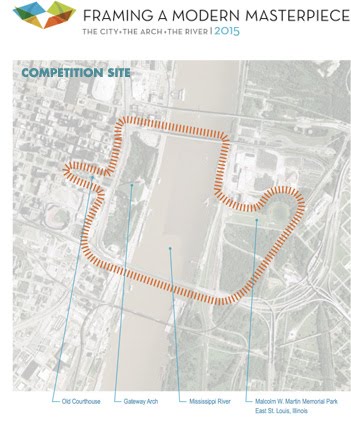
The City + Arch + River design competition is intended to overcome the island effect and reconnect the Arch and riverfront to the city. Restablishing connectivity is the common theme of the new Jefferson National Expansion Memorial General Management Plan and the Arch design competition.
What we don't want to see happen is an expansion of the federal island. If the competition program is about reweaving connections between the riverfront, downtown, and the Arch, then the boundaries of the competition are where the design is most important.
If the St. Louis Art Museum, History Museum, and Science Center were all moved to the Arch grounds, would that increase visits to downtown? The Jefferson National Expansion Museum already has two museums, one under the Arch and one in the Old Court House. But if you ask visitors to the Arch, what drew them to the site, would they tell you it was the Arch or the museums? Most would say it was the Arch. "There's nothing wrong with the Arch; there's nothing wrong with the Arch".
Would a restaurant on the grounds of the Statue of Liberty draw more visitors to the Statue of Liberty? Would a museum alongside the Eifel Tower draw more visitors to the Eifel Tower? Like these two iconic landmarks, people come to see the icon.
Another goal of the design compeition is to catalyze the Arch grounds as a way to enliven downtown. Hence, downtown should be the destination for services, not the landmark. Looking at the possible downside, if there were a new restaurant or other services offered on the Arch grounds, they might siphon off customers who would otherwise patronize downtown restaurants and local businesses.
How do new attractions on the Arch grounds or the East St. Louis riverfront improve the connection between the riverfront, downtown and the Arch grounds? It is hard to see how they do.
If reestablishing connectivity is the biggest goal of the design competition, then the number one goal of the program should be to solve the connection problem and secure funding to make it happen before planning new attractions.
What St. Louis does not need is a nicer island in the heart of downtown. What people are calling for is a City that is reconnected to the River.
Friday, June 25, 2010
Friday rewind
Summer is Farmer's Market season in St. Louis, and downtown is in on the action:

Washington Avenue gets lots of attention and is home to cool places on every block, but Olive Street has a real urban canyon feel too, and is seeing a big increases in pedestrian traffic:

I vote for Olive to be the place to host downtown's next parade. Narrow city streets make the best parade venues.

Washington Avenue gets lots of attention and is home to cool places on every block, but Olive Street has a real urban canyon feel too, and is seeing a big increases in pedestrian traffic:

I vote for Olive to be the place to host downtown's next parade. Narrow city streets make the best parade venues.
Ecology of Absence has moved
It is now part of Michael Allen's Preservation Research Office website. Links have been updated.
Wednesday, June 23, 2010
A sustainable future for the Mississippi watershed?
That's what river interests are considering this week in St. Louis. The timing of their meeting could not be better as it comes just before the second round of mid- course reviews for the teams competing in the Arch design competition.
Early plans to reinvigorate the downtown St. Louis riverfront included such ideas as manmade, floating islands. But those were ruled out due to the frequent flooding and fast currents of the river at St. Louis.
The Mississippi watershed is one of the largest in the world, and having its future planned in St. Louis is a great opportunity. Weaving these efforts together with the future of the Arch grounds provides further opportunities for connecting St. Louis with its historic riverfront, creating sustainable futures for the river and the riverfront.
There is more reading to do. What defines a "sustainable watershed"? With all the water the Mississippi River carries, what distinguishes it from being a sustainable or non-sustainable watershed? The answer probably has something to do with such things as flood plains, flooding, dams, river travel, and farmlands...
Early plans to reinvigorate the downtown St. Louis riverfront included such ideas as manmade, floating islands. But those were ruled out due to the frequent flooding and fast currents of the river at St. Louis.
The Mississippi watershed is one of the largest in the world, and having its future planned in St. Louis is a great opportunity. Weaving these efforts together with the future of the Arch grounds provides further opportunities for connecting St. Louis with its historic riverfront, creating sustainable futures for the river and the riverfront.
There is more reading to do. What defines a "sustainable watershed"? With all the water the Mississippi River carries, what distinguishes it from being a sustainable or non-sustainable watershed? The answer probably has something to do with such things as flood plains, flooding, dams, river travel, and farmlands...
Wednesday, June 16, 2010
Trust for Public Land covers City to River, DOT shared interests...
Is the City to River downtown St. Louis boulevard plan aligned with new US Department of Transportation urban infrastructure strategies?
The boulevard can brighten your day!

Does driving the depressed lanes or on the top of an elevated highway lift your spirits? Does the experience improve your daily routine? Does it make you happy?
What about driving through Forest Park? Do you ever plan your trips through the park when connecting between Point A and Point B? I know I do. There are lots of ways to go, but the beauty of the drive through the park makes for a better day. I like seeing the green of the park rather than the grey of concrete.
Do you think a landscaped boulevard, possibly with a fountain or two, and views of the Eads Bridge, the Arch and Old Court House might have the same effect? Would it be a nicer way to make your way through town than on a buried highway or elevated interstate?
Tuesday, June 15, 2010
What he said...
Guest PD Columnist, Brad Fratello, writes about the proposed downtown boulevard plan:
City to River says lose "The Lid", back "The Boulevard"
The print edition has four color before and after photos. Pick up a copy to share with friends!
City to River says lose "The Lid", back "The Boulevard"
The print edition has four color before and after photos. Pick up a copy to share with friends!
Monday, June 14, 2010
Arch boulevard to catalyze $1.2 billion in new downtown investments?
City to River cites Development Strategies statistics on the development potential created by a new boulevard next to the Arch.
Post Dispatch reports on the possibility of a new Memorial Drive.
Lots of updates and questions answered at the City to River website...
For those wondering about the development of downtown, remember that over the last ten years, downtown growth has exceeded by many multiples goals as set forth in the Downtown Now plan.
The formula calls for a public/private partnership whereby updated infrastructure brings about economic growth. We have done it before and we can do it again.
Post Dispatch reports on the possibility of a new Memorial Drive.
Lots of updates and questions answered at the City to River website...
For those wondering about the development of downtown, remember that over the last ten years, downtown growth has exceeded by many multiples goals as set forth in the Downtown Now plan.
The formula calls for a public/private partnership whereby updated infrastructure brings about economic growth. We have done it before and we can do it again.
Friday, June 11, 2010
Thursday, June 10, 2010
Active streets in downtown - what works?

The view above is taken around 5:15 pm from northbound 7th Street about two hours before game time. Over the next two hours, cars and pedestrians crowd the streets and sidewalks in front of Busch Stadium.
Around the corner, on the south side of Busch, there is the elevated structure of Interstate 64. It casts a shadow over the area, creates a foreboding presence, and there are few pedestrians and little streetlife. The condition is not unlike the area along the riverfront, Laclede's Landing, and the Arch grounds created by the presence of Interstate 70.
The boulevard plan proposed by City to River creates a connection between activity generators (the Arch, riverfront, and downtown neighborhoods) encouraging street life. Currently, the area instead is dominated by the presence of an interstate, which acts to deaden the area and discourage street life, just as we see along the south side of Busch Stadium.
The riverfront, Arch grounds, and downtown neighborhoods are already good activity generators or "assets". But generally, all of these areas have minimal street life, especially around the Arch and riverfront. So, the question is, which draws street life, good streets or activity generators?
City to River has created a "What You Can Do" page at the City to River website. If you want to see a pedestrian friendly boulevard in place of the soon-to-be-former downtown lanes of Interstate 70, consider taking these steps in support of the City to River effort.
Tuesday, June 01, 2010
Iron Barley Rib Fest
Down on Virginia at Bates, Iron Barley owners Jenn and Tom Coghill hosted their annual Memorial Day Rib Fest and fundraiser. A block of Virginia was closed for the food booths, beverage stands, and music stage.

This year's event raised funds for the USO and Fisher House, a veteran's service home offering family members of wounded veterans a place to stay while their loved ones undergo medical care.
Here's Fred Friction, booking agent for Iron Barley, celebrating with one of the winning barbeque contestants.

And here are Jenn and Tom awarding one of the Rib Fest trophies.

With the Rib Fest a wrap, Iron Barley devotees will have to wait a couple of weeks while the staff gets a much deserved break and the restaurant goes through some inside updates.
When the restaurant reopens, be sure to visit for some of the best food in all of St. Louis.

This year's event raised funds for the USO and Fisher House, a veteran's service home offering family members of wounded veterans a place to stay while their loved ones undergo medical care.
Here's Fred Friction, booking agent for Iron Barley, celebrating with one of the winning barbeque contestants.

And here are Jenn and Tom awarding one of the Rib Fest trophies.

With the Rib Fest a wrap, Iron Barley devotees will have to wait a couple of weeks while the staff gets a much deserved break and the restaurant goes through some inside updates.
When the restaurant reopens, be sure to visit for some of the best food in all of St. Louis.
Friday, May 28, 2010
Danforth Said it Best
Back in the days of St. Louis 2004, Senator John Danforth said it best when he proclaimed "St. Louis is not a spectator sport". His point was that everyday people need to get personally involved in the effort to improve St. Louis.
Reading blogs and watching television is not enough. Knowing what's best isn't enough. People have to get off the sidelines and do things. Now is one of those key times when regular, everyday people can make a difference in the future of our city.
There is a push on in our community right now to have an impact on the future of downtown St. Louis and the riverfront. If you are a regular visitor of this site, you know what it is: City to River is working to remove the downtown lanes of I-70that have been the physical and psychological barrier dividing downtown from the Arch grounds and riverfront.
Now is the time and this your opportunity to help make it happen. Click here to find out how.
Reading blogs and watching television is not enough. Knowing what's best isn't enough. People have to get off the sidelines and do things. Now is one of those key times when regular, everyday people can make a difference in the future of our city.
There is a push on in our community right now to have an impact on the future of downtown St. Louis and the riverfront. If you are a regular visitor of this site, you know what it is: City to River is working to remove the downtown lanes of I-70that have been the physical and psychological barrier dividing downtown from the Arch grounds and riverfront.
Now is the time and this your opportunity to help make it happen. Click here to find out how.
Wednesday, May 26, 2010
Windshield Survey (with frequent updates)

One of the top concerns regarding converting the soon-to-be-former downtown lanes of I-70 into a new at-grade boulevard is how to handle the truck traffic.
With the rerouting of I-70 north of downtown over the new Mississippi River bridge, all of the east and west bound I-70 through truck traffic currently using the depressed lanes and Poplar Street Bridge will be diverted away from downtown over the new bridge.
However, to get an idea of the volume of truck traffic through the area today, this week I started doing my own survey. I've been counting oversized vehicle traffic along the depressed lanes continuing south on I-55 toward South County.

To date, I've completed three counts. When counting I count all oversized vehicles coming in the opposite direction, plus all the oversized vehicles travelling in front of me and behind me as far as I can see in my direction. The counts are being taken during morning rush hour.
The first count was on northbound 55 between Gasconade and exiting Memorial Drive at around 7:15 am (about 3.5 miles). Total oversized vehicle traffic: 41 vehicles
The second count was taken from Memorial Drive through southbound 55 to the Germania exit (about 6.5 miles) at around 8:15 am: Total oversized vehicle traffic: 59 vehicles
The third count was taken on northbound 55 from River des Peres through to the Memorial Drive exit at about 8:50 am: Total oversized vehicle traffic: 61 vehicles.
We are counting school buses and UPS sized panel trucks, but not pickup-styled small contractor trucks.
School buses and panel vans comprise about 1/2 the total oversized vehicle counts. Full size over the road tractor trailers comprise about the other 50%.
Compared to total vehicle traffic, oversized vehicles appear to take up less than 10 percent of all traffic through the area. Truck traffic is present, but does not appear to be an overly high percentage of overall traffic volume.
UPDATE - Thursday, May 27
Counting cars at 6:36 am on northbound I-55 from River Des Peres to the Memorial Drive exit, there were a total of 63 oversized vehicles, with approximately half of them school buses. So many school buses on the highway in the morning makes you wonder if all those buses are carrying kids headed toward St. Louis County as part of the deseg program?
Monday, May 24, 2010
One More Bridge to Go?

Friday's celebration surrounding the demolition of the St. Louis Centre skybridge over Washington Avenue clears the way for one more step towards the revitalization of downtown St. Louis. The removal of the skybridge creates an uninterrupted streetscape view down Washington Avenue - to the west.
The view above is what will be revealed looking east - the nearly fifty-year old elevated lanes of I-70 above Memorial Drive. Just beyond the elevated lanes are the Eads Bridge, the Mississippi River, the Arch grounds, Laclede's Landing and a Metrolink station.
Imagine in place of the elevated lanes a new, at-grade, pedestrian friendly boulevard. An at grade boulevard in place of the elevated lanes creates clear views east and west along Washington Avenue.
The all-volunteer citizens group City to River is proposing just that, with the goal of seeing teams competing in the Arch design competition propose highway removal as part of their design solutions to reconnect the city to the riverfront and Arch grounds.
For more information on City to River's efforts to replace the soon-to-be-former elevated and depressed lanes of I-70 through downtown with a new urban boulevard, visit the City to River website or contact info@citytoriver.org.
Tuesday, May 18, 2010
Old time St. Louis alive and well
This post isn't so much about St. Louis rising as it is about St. Louis at its best.
Epiphany Church on Ivanhoe is one of the city's many Catholic parishes.

Epiphany has its own bowling alley and a few years ago the parish installed mechanized pin setters to take the place of the old hand setters.

In 2010, the church is launching a blog. You can visit the site here: Ephipany blog. Epiphany's new website contains much more information than is usually found in blogs.
The site contains plentiful information about the church and parish, and even includes one of those elusive parish boundary maps, along with a legal description of the parish boundary. In a city known for having many overlapping boundaries and districts, some of the most interesting of all are the boundaries of Catholic parishes.
Ivanhoe is one of those classic historic streets in St. Louis. Within walking distance of the church, you find lots of gems. One of those is Pizza A Go Go. The pizza is some of the best in town. Pizza A Go Go has excellent pizza but is also known for some quirky rules.
Pizza A Go Go's website is actually a blog. The comments there are a testament to the quality of the pizza, but be sure to also read the strict enforcement of the house rules for ordering pizza. Pizza A Go Go does not sell beer, but customers have been known to bring their own, keeping it chilled in the cooler located in the small dining room. If you think the building is an old service station, you are probably right.

Across from Pizza A Go Go is Killer Vintage. Killer Vintage specializes in vintage musical instruments and amplifiers. The store has one of the finest collections in the midwest.

With so much diversity at a walkable scale, old neighborhoods are cool and interesting places. They have lots of unique small businesses, historic homes, bowling alleys, and churches. A mile or so west of Ivanhoe is Sutton in Maplewood. Sutton competes with Ivanhoe for being one of the nicest neighborhood settings in St. Louis. Along Sutton, some of the historic homes are finding new uses as professional offices.

And there are also cool churches, including the one shown below, ornamented with tons of terra cotta. I have not seen the inside of this one, but according to local legend, the interior of this church served as one of the sets for George Clooney's recent "Up In the Air" film.

With so much going for it, Sutton also boasts what is possibly the coolest bowling alley in St. Louis, the Saratoga Lanes, located on the second floor of this building:

If you buy an old guitar at Killer Vintage, you will need a place to have it repaired, and Goez Stringed Instrument shop is a place to go. They're located in this building, also on Sutton:

And when you have that vintage instrument sounding its best, there are a number of fine venues along Sutton for performance, one of the best being the Focal Point:

The St. Louis area is blessed to have many areas like the very walkable Sutton and Ivanhoe neighborhood districts. They offer charm and a sense of place that increase the quality of our lives. If you're looking for an interesting place to do some shopping, spend a leisurely afternoon or evening, or find a new home, check out these places and our other friendly neighborhood choices.
Epiphany Church on Ivanhoe is one of the city's many Catholic parishes.

Epiphany has its own bowling alley and a few years ago the parish installed mechanized pin setters to take the place of the old hand setters.

In 2010, the church is launching a blog. You can visit the site here: Ephipany blog. Epiphany's new website contains much more information than is usually found in blogs.
The site contains plentiful information about the church and parish, and even includes one of those elusive parish boundary maps, along with a legal description of the parish boundary. In a city known for having many overlapping boundaries and districts, some of the most interesting of all are the boundaries of Catholic parishes.
Ivanhoe is one of those classic historic streets in St. Louis. Within walking distance of the church, you find lots of gems. One of those is Pizza A Go Go. The pizza is some of the best in town. Pizza A Go Go has excellent pizza but is also known for some quirky rules.
Pizza A Go Go's website is actually a blog. The comments there are a testament to the quality of the pizza, but be sure to also read the strict enforcement of the house rules for ordering pizza. Pizza A Go Go does not sell beer, but customers have been known to bring their own, keeping it chilled in the cooler located in the small dining room. If you think the building is an old service station, you are probably right.

Across from Pizza A Go Go is Killer Vintage. Killer Vintage specializes in vintage musical instruments and amplifiers. The store has one of the finest collections in the midwest.

With so much diversity at a walkable scale, old neighborhoods are cool and interesting places. They have lots of unique small businesses, historic homes, bowling alleys, and churches. A mile or so west of Ivanhoe is Sutton in Maplewood. Sutton competes with Ivanhoe for being one of the nicest neighborhood settings in St. Louis. Along Sutton, some of the historic homes are finding new uses as professional offices.

And there are also cool churches, including the one shown below, ornamented with tons of terra cotta. I have not seen the inside of this one, but according to local legend, the interior of this church served as one of the sets for George Clooney's recent "Up In the Air" film.

With so much going for it, Sutton also boasts what is possibly the coolest bowling alley in St. Louis, the Saratoga Lanes, located on the second floor of this building:

If you buy an old guitar at Killer Vintage, you will need a place to have it repaired, and Goez Stringed Instrument shop is a place to go. They're located in this building, also on Sutton:

And when you have that vintage instrument sounding its best, there are a number of fine venues along Sutton for performance, one of the best being the Focal Point:

The St. Louis area is blessed to have many areas like the very walkable Sutton and Ivanhoe neighborhood districts. They offer charm and a sense of place that increase the quality of our lives. If you're looking for an interesting place to do some shopping, spend a leisurely afternoon or evening, or find a new home, check out these places and our other friendly neighborhood choices.
Thursday, May 13, 2010
People on the street?
One of the goals urban planners have to revitalize downtown areas is to get more people on the street - more pedestrian activity. St. Louis is often criticized for lacking pedestrian activity and having no street life. So I was trying to think where in our downtown are there throngs of people on the sidewalks, right alongside busy vehicular traffic? Anywhere?

Yes! Right outside new Busch Stadium!
At the same time downtown office buildings are emptying out and workers are headed to their cars, thousands of baseball game visitors are walking to Busch Stadium. The combination of these two events creates a heavy amount of pedestrian and vehicular traffic on the east and west sides of Busch Stadium.
It works. Before every ballgame there are street musicians, traffic cops on foot and in golf carts, lots and lots of people, sidewalk vendors, and happy people and urban vibrancy.
So then if we apply what we've learned with the new ballpark to the ongoing Arch design competition, why not repeat this success and create a new pedestrian friendly boulevard alongside the Arch grounds, one that reconnects St. Louis to the riverfront?
They say Missouri is the "Show Me State". At Busch Stadium we have proof that cars and people can mix, and create a vibrant street. Let's build on that success and extend an active downtown street grid to the riverfront!

Yes! Right outside new Busch Stadium!
At the same time downtown office buildings are emptying out and workers are headed to their cars, thousands of baseball game visitors are walking to Busch Stadium. The combination of these two events creates a heavy amount of pedestrian and vehicular traffic on the east and west sides of Busch Stadium.
It works. Before every ballgame there are street musicians, traffic cops on foot and in golf carts, lots and lots of people, sidewalk vendors, and happy people and urban vibrancy.
So then if we apply what we've learned with the new ballpark to the ongoing Arch design competition, why not repeat this success and create a new pedestrian friendly boulevard alongside the Arch grounds, one that reconnects St. Louis to the riverfront?
They say Missouri is the "Show Me State". At Busch Stadium we have proof that cars and people can mix, and create a vibrant street. Let's build on that success and extend an active downtown street grid to the riverfront!
More of these please!

One of the best things about walkable neighborhoods is the way they open up possibilites beyond the front walk. Here is an example of a courtyard patio located in the back area of a popular restaurant. You access the courtyard either through the main building or via a gated entrance on the side street.
This patio features beautiful flowers and plants, terraces, cast iron tables and chairs, fish ponds, an iron fountain, multiple bar areas, a huge, shady covered section, lots of nice brick, and a full service food and bar menu.
Sidewalk cafes are great, but interior courtyards are my favorite. They bring a little bit of New Orleans to St. Louis. They are hidden jewels inside cool neighborhoods. There aren't very many in St. Louis. I can't think of one in the Central West End or Lafayette Square neighborhoods. The one pictured here is in Soulard. Are there others?
Tuesday, May 11, 2010
Sidewalk threat!

Last week we called attention to a dangerous fence lining "Ballpark Village" operated by the Cardinals (nothing's changed with the fence since last week).
Today, we feature a section of sidewalk that is poised to stub toes, trip dog walkers, and generally cause all kinds of trouble.
Lifted sidewalks are a fact of life when you have mature street trees. Some trees cause more sidewalk damage than others. I'll take the big trees, and live with the uneven sidewalks.
If the owner here is cited by the city to repair the sidewalk, there is a program available to help with the cost.
Monday, May 10, 2010
Arch contest not your grandmother's design competition
In the mid-1940s, when Eero Saarinen proposed his iconic Arch design, telephones had dials, St. Louis had almost 900,000 residents, engineers used slide rules, the first electronic computers were being developed, gasoline cost about 15 cents per gallon and the US had just come out of World War II.
Seventy years later, people use their phones as computers, gasoline costs nearly $3.00 per gallon, the population of St. Louis has dropped by 60 percent, the US lost in Viet Nam but won WW2 and the Cold War, and, we have the internet - the technology that is changing everything.
We live in a different world, one with a trend towards increasing transparency. How will the final five teams in the Arch design competition tailor their work to our current times? Will they take advantage of the internet to engage the public in the design process? Will they seek community input online? Would opening up their design work put them at a competitive disadvantage? Or would it make their proposal stronger?
One of the most interesting elements of the Arch design competition is that this effort is more about fixing broken connections between the Arch, riverfront and downtown, than doing anything with the Arch itself. Those bad connections are where the city of St. Louis meets the National Park.
With the close connection between the City of St. Louis and the Jefferson National Expansion Memorial, how should the public be engaged in the development of the design to reconnect the city to the riverfront and Arch grounds, if at all? The technology is in place to make the design process completely transparent and interactive.
For the Arch design competition, will average citizens get their first glimpse of the design team's plans just weeks before the winning team and design is chosen, or will the general public from both sides of the river be engaged in the process of helping determine the winning design that will set the tone and direction for the future of the Arch grounds, the riverfront, downtown St. Louis, and the region?
(Post edited with thanks to comment from reader "Jeem")
Seventy years later, people use their phones as computers, gasoline costs nearly $3.00 per gallon, the population of St. Louis has dropped by 60 percent, the US lost in Viet Nam but won WW2 and the Cold War, and, we have the internet - the technology that is changing everything.
We live in a different world, one with a trend towards increasing transparency. How will the final five teams in the Arch design competition tailor their work to our current times? Will they take advantage of the internet to engage the public in the design process? Will they seek community input online? Would opening up their design work put them at a competitive disadvantage? Or would it make their proposal stronger?
One of the most interesting elements of the Arch design competition is that this effort is more about fixing broken connections between the Arch, riverfront and downtown, than doing anything with the Arch itself. Those bad connections are where the city of St. Louis meets the National Park.
With the close connection between the City of St. Louis and the Jefferson National Expansion Memorial, how should the public be engaged in the development of the design to reconnect the city to the riverfront and Arch grounds, if at all? The technology is in place to make the design process completely transparent and interactive.
For the Arch design competition, will average citizens get their first glimpse of the design team's plans just weeks before the winning team and design is chosen, or will the general public from both sides of the river be engaged in the process of helping determine the winning design that will set the tone and direction for the future of the Arch grounds, the riverfront, downtown St. Louis, and the region?
(Post edited with thanks to comment from reader "Jeem")
Friday, May 07, 2010
KFUO Sale
Over the past year, the possible sale of Classic 99 KFUO in St. Louis has been in the news. Classical music lovers are concerned about the sale because KFUO is the only classical music station in St. Louis.
The Lutheran Church Missouri Synod owns KFUO and a buyer plans to turn the station into a Christian Rock format. The FCC has approved the sale and it's supposed to close in a week.
Here's the part I find amazing: the price. The buyer is reportedly paying $18 million for the station plus another $8 million in interest. How is a small to mid-sized FM radio station in St. Louis possibly worth that much? From what I understand, the value is in the license. But $26 million?
Ad revenues are down in all traditional forms of media. Internet and satellite music options are growing. And a local radio station sells for over $20 million? How do the buyers plan to make any money or just break even?
The Lutheran Church Missouri Synod owns KFUO and a buyer plans to turn the station into a Christian Rock format. The FCC has approved the sale and it's supposed to close in a week.
Here's the part I find amazing: the price. The buyer is reportedly paying $18 million for the station plus another $8 million in interest. How is a small to mid-sized FM radio station in St. Louis possibly worth that much? From what I understand, the value is in the license. But $26 million?
Ad revenues are down in all traditional forms of media. Internet and satellite music options are growing. And a local radio station sells for over $20 million? How do the buyers plan to make any money or just break even?
Thursday, May 06, 2010
USA Today covers City to River
Newsline:
"Downtowns go from gray to green"
"Cities from Los Angeles to Cincinnati are remaking concrete barriers into parks, open spaces."
Link to full story
"Downtowns go from gray to green"
"Cities from Los Angeles to Cincinnati are remaking concrete barriers into parks, open spaces."
Link to full story
Kids of city firefighters to get school choice?
A new bill pending in Jefferson City would end city residency requirements for firefighters after they've put in seven years of service. The bill mirrors a law passed a few years ago relieving veteran city police officers of city residency requirements. The stated purpose for the change is to give families of firefighters the freedom to move out of the city so their children have the opportunity to enroll in higher performing public school districts.
Does this mean that soon the state will follow the same logic and propose the end of residency requirements for all city employees? If the goal of the state is to offer city school-aged children better educational options, why should the effort be limited to children of city employees?
Aside from the irony that city employees are relieved of residency requirements to seek better public school options (while non-government employee city residents are given no special consideration), shouldn't the goal of the state be to ensure that all its residents have the best educational opportunities, regardless of where they live or for whom they work?
Rather than lift city residency requirements for city employees, what about changing the rules so that all city residents are allowed to enroll their children in schools outside the city? That single change to public policy would answer once and for all the decades old objection that "we'd love to live in the city except for the public schools".
For parents of city school children who enroll their kids in private schools (while paying taxes to fund the city schools), why not allow some or all of private elementary and high school tuition to be tax deductible for families living in school districts with underperforming public schools?
Does this mean that soon the state will follow the same logic and propose the end of residency requirements for all city employees? If the goal of the state is to offer city school-aged children better educational options, why should the effort be limited to children of city employees?
Aside from the irony that city employees are relieved of residency requirements to seek better public school options (while non-government employee city residents are given no special consideration), shouldn't the goal of the state be to ensure that all its residents have the best educational opportunities, regardless of where they live or for whom they work?
Rather than lift city residency requirements for city employees, what about changing the rules so that all city residents are allowed to enroll their children in schools outside the city? That single change to public policy would answer once and for all the decades old objection that "we'd love to live in the city except for the public schools".
For parents of city school children who enroll their kids in private schools (while paying taxes to fund the city schools), why not allow some or all of private elementary and high school tuition to be tax deductible for families living in school districts with underperforming public schools?
Monday, May 03, 2010
Occasional Planet on Highway Removal
Local writer Gloria Shur Bilchik writes about highway removal in front of the Arch at the Real Change, One Idea at a Time "Occasional Planet" website.
Heads Up!

"Heads Up!"
At youth baseball games, that's the cry you hear whenever a foul ball is headed to the stands, especially if it's on its way to a place where people might not see it coming.
Meanwhile, in the big leagues, next to Busch III, someone might want to warn passers by with the same familar call about the fence that lines the long- delayed Ballpark Village site. Pedestrians need to watch out that they don't accidentally hit their heads or end up with an eye injury thanks to the razor sharp top of the BP Village fence that is jutting into the sidewalk.
This wayward section of fence is right in the same location where lines of tourist buses park to pick up and drop off passengers attending Cardinal games. The sidewalk carries thousands of pedestrians on their way to and from ballgames.
Maybe this is the year the fence around Ballpark Village will come down? In the meantime, better keep your "heads up"!
Friday, April 30, 2010
Arch as Destination or Arch as Urban Fabric?
Or both?
For the past 40 + years, the Arch has been a destination. Unfortunately, in the way it is cut off from downtown by the highway, the Arch is not much a part of the urban fabric of St. Louis. Sponsors of the design competition compare the setting of the Arch to an island. Others have less charitable words to describe it.
Now we are entering an historic competition to determine the future of the Arch grounds and hopefully transform our downtown area, the Arch, the riverfront, and the connections between all of them.
This week the five finalist teams for the Arch design competition introduced themselves to St. Louis. They have a big job ahead of them. Estimates on the numbers of visitors to the Arch each year approach 3,000,000. Getting those visitors to stay longer in St. Louis after an Arch visit is a goal for our community and the competition.
Another goal of the competition, perhaps the most of all, is to "weave the Arch into the City". We will know in a few months what that looks like in the eyes of the design teams. If the plan succeeds, weaving the Arch into the city will help keep more Arch visitors in St. Louis, and that means increased economic activity for St. Louis and a healthier downtown and region.
The Arch is framed by barriers. The competition is called "Framing a Modern Masterpiece". Ironic? Maybe. The designers are challenged to overcome those barriers - principally the highway - "frame" the Arch, create an iconic setting worthy of the landmark (and St. Louis!), and connecting everything together with the riverfront.
At the "Meet the Design Teams" event, all the designers seemed intrigued by the challenge. This project isn't just about building one building, designing a park or memorial, reinvigorating a dead waterfront, or revitalizing a historic downtown, it's about all of that!
For the past 40 + years, the Arch has been a destination. Unfortunately, in the way it is cut off from downtown by the highway, the Arch is not much a part of the urban fabric of St. Louis. Sponsors of the design competition compare the setting of the Arch to an island. Others have less charitable words to describe it.
Now we are entering an historic competition to determine the future of the Arch grounds and hopefully transform our downtown area, the Arch, the riverfront, and the connections between all of them.
This week the five finalist teams for the Arch design competition introduced themselves to St. Louis. They have a big job ahead of them. Estimates on the numbers of visitors to the Arch each year approach 3,000,000. Getting those visitors to stay longer in St. Louis after an Arch visit is a goal for our community and the competition.
Another goal of the competition, perhaps the most of all, is to "weave the Arch into the City". We will know in a few months what that looks like in the eyes of the design teams. If the plan succeeds, weaving the Arch into the city will help keep more Arch visitors in St. Louis, and that means increased economic activity for St. Louis and a healthier downtown and region.
The Arch is framed by barriers. The competition is called "Framing a Modern Masterpiece". Ironic? Maybe. The designers are challenged to overcome those barriers - principally the highway - "frame" the Arch, create an iconic setting worthy of the landmark (and St. Louis!), and connecting everything together with the riverfront.
At the "Meet the Design Teams" event, all the designers seemed intrigued by the challenge. This project isn't just about building one building, designing a park or memorial, reinvigorating a dead waterfront, or revitalizing a historic downtown, it's about all of that!
MoDOT to Arch Design Teams: "We are open to highway removal"
From a recent "Road Crew" Live Chat at STL Today comes the following Q and A with local highway officials including MoDOT Spokesperson, Linda Wilson:
Pat: "There has been a lot talk about possibly removing the section of Interstate 70 downtown when the new Mississippi River Bridge is finished. It could potentially revitalize a lot of the St. Louis riverfront with more pedestrian friendly areas and more commercial space if it was removed.
How opposed is MoDot to removing that section of I-70 in the future? I have heard reasons against the removal because people coming from 55 can't go to north st. louis and vice-versa (which makes sense). Has MoDot done or will they do any studies determining how much the removal of that section would affect drivers? Does MoDot take into account the possible benefits a removal could have for downtown St. Louis?"
Linda Wilson, Todd Waelterman and David Wrone: "Our district engineer is serving on the technical advisory committee for the Arch contest. Our position is that after we build the new Mississippi River bridge downtown, there will still be a demand of 50,000+ vehicles per day to drive the section of highway that runs in front of the Arch. Some of that traffic is north-south driving from north county to south county or vice versa. It does serve as an alternate north-south to I-270. The other significant portion of traffic is people who go to and from work in downtown St. Louis every day. We have told the groups that if they can develop a plan to accommomdate how these 50,000+ vehicles can get through, we are open to looking at it".
Linda Wilson, MoDOT
Pat: "There has been a lot talk about possibly removing the section of Interstate 70 downtown when the new Mississippi River Bridge is finished. It could potentially revitalize a lot of the St. Louis riverfront with more pedestrian friendly areas and more commercial space if it was removed.
How opposed is MoDot to removing that section of I-70 in the future? I have heard reasons against the removal because people coming from 55 can't go to north st. louis and vice-versa (which makes sense). Has MoDot done or will they do any studies determining how much the removal of that section would affect drivers? Does MoDot take into account the possible benefits a removal could have for downtown St. Louis?"
Linda Wilson, Todd Waelterman and David Wrone: "Our district engineer is serving on the technical advisory committee for the Arch contest. Our position is that after we build the new Mississippi River bridge downtown, there will still be a demand of 50,000+ vehicles per day to drive the section of highway that runs in front of the Arch. Some of that traffic is north-south driving from north county to south county or vice versa. It does serve as an alternate north-south to I-270. The other significant portion of traffic is people who go to and from work in downtown St. Louis every day. We have told the groups that if they can develop a plan to accommomdate how these 50,000+ vehicles can get through, we are open to looking at it".
Linda Wilson, MoDOT
Monday, April 26, 2010
Blog Watch: STL Energized
A native Midwesterner has returned from a life in Northern California to raise a family in St. Louis and take part in our region's renewal.
He (or she?) is a practicing real estate attorney with some very positive ideas about the present and future of St. Louis. The person has started a blog called "STL Energized".
For its first post, STL Energized lays out a detailed proposal for how to revitalize the Arch grounds and reconnect the City to the River.
On a personal level, being another former Northern Californian, I hope to read more on this writer's views about relocating to St. Louis from the Golden State.
He (or she?) is a practicing real estate attorney with some very positive ideas about the present and future of St. Louis. The person has started a blog called "STL Energized".
For its first post, STL Energized lays out a detailed proposal for how to revitalize the Arch grounds and reconnect the City to the River.
On a personal level, being another former Northern Californian, I hope to read more on this writer's views about relocating to St. Louis from the Golden State.
Best Alley Award

Living in a house with a garage sized more for smoking meat than parking cars makes me yearn for the day when we might have one that offers the service utility and alley charm as the one shown above.
This beauty is in Shaw and would be a welcome addition to most any home or alley.
Friday, April 23, 2010
If LRA properties were free, would you take one?
The city has a major budget deficit. It also holds title to a lot of abandoned real estate through the Land Reutilization Authority (LRA). The land owned by LRA costs the city money to maintain and does not generate any tax revenue. The city offers these properties for sale but still has a heavy cost burden maintaining the inventory.
What if these properties were offered to the public for free? Not all of them say, but starting with just the vacant lots? If you could acquire a vacant LRA lot for free, with a guaranteed tax bill of say $100 per year and requirements to keep the lot cut, would you want one? Two?
What would you do with the property? Assume it has a collapsed building buried under the ground. Cost to excavate and haul away the old building would likely run in the $10,000 - $15,000 range. If you left it there, the land wouldn't be good for much construction, and it would be hard to grow trees with all the brick and stone debris just a few feet below the surface.
Nonetheless, you'd own the ground - and everything in it. Over time, if development came your way, the land might be worth something. If you were a neighbor, you could fence the lot and expand your own yard. And you'd be saving the city money.
Free land. Would you take the offer?
What if these properties were offered to the public for free? Not all of them say, but starting with just the vacant lots? If you could acquire a vacant LRA lot for free, with a guaranteed tax bill of say $100 per year and requirements to keep the lot cut, would you want one? Two?
What would you do with the property? Assume it has a collapsed building buried under the ground. Cost to excavate and haul away the old building would likely run in the $10,000 - $15,000 range. If you left it there, the land wouldn't be good for much construction, and it would be hard to grow trees with all the brick and stone debris just a few feet below the surface.
Nonetheless, you'd own the ground - and everything in it. Over time, if development came your way, the land might be worth something. If you were a neighbor, you could fence the lot and expand your own yard. And you'd be saving the city money.
Free land. Would you take the offer?
Friday, April 16, 2010
Tokyo Meets St. Louis

I have never been to Tokyo, but from the images and stories you see on TV, it seems like a highly energetic place with lots of cool high tech gadgets and electronic stuff mixed into the environment. Now St. Louis has something like that right here.
At the corner of 8th and Olive, across the street from the Old Post Office and a block from the new Schnuck's Culinaria, there's an interactive video game installed in the storefront window of the Alexa Lofts building. I tried it. It works.
People on the sidewalk play the game by touching the windows and activating the flat screen panels. It's a flashy, high-tech production, and you can win prizes including value towards discounted air travel.
STL Tradition Needs Your Support

The news is reporting that InBev has started charging a $2,000 appearance fee for bringing the famed Budweiser Clydesdales to your community event. $2,000 is a low price to pay for one of the world's most recognized corporate symbols. It's downright cheap. For comparison, an inflatable jumpie rents for about $450.
The season for parish picnics, school parades, and block parties is right around the corner. Why not consider hiring the Budweiser Clydesdales to be a featured attraction? You would be doing your part to maintain a long time local tradition and your event would have bragging rights for years to come!
Wednesday, April 14, 2010
What economists say
Listening to NPR yesterday about the future of the US and world economy, one of the guests being interviewed said that an economy based on limitless growth is unsustainable. If a sprawl economy is based on constant growth, then does it follow that an economy which retrofits and maintains its older areas is more sustainable?
As we look to strengthen communities and our economy over the next 20-30 years, are there long term opporunities both in terms of jobs and economic growth by focusing on a program of community renewal? What would something like that look like? How would an economist measure the costs and benefits? We can use the St. Louis region as a case study.
Parts of the core of the St. Louis region have seen decades of dramatic disinvestment and decline. At the same time, the region has seen a nearly equal amount of sprawl based growth on the edges of the metropolitan area. Today, growth at the outer reaches of the region has slowed dramatically.
Housing developments in those areas have stalled, homebuilders have gone out of business, and property values are flat or decreasing. At the same time, values closer to the center of the region have been stable to slowly increasing. Are we better served working to maintain our established systems and built environment rather than constantly expanding them?
Are there opportunities to create a combination of more community gardens, farmer's markets, and expanded use of green building practices; increased school choice, expanded supply of affordable housing and more public transportation options; and support for small businesses, and retrofitting of commercial corridors to help position St. Louis as a region of choice for families and businesses over the next 30 years?
As we look to strengthen communities and our economy over the next 20-30 years, are there long term opporunities both in terms of jobs and economic growth by focusing on a program of community renewal? What would something like that look like? How would an economist measure the costs and benefits? We can use the St. Louis region as a case study.
Parts of the core of the St. Louis region have seen decades of dramatic disinvestment and decline. At the same time, the region has seen a nearly equal amount of sprawl based growth on the edges of the metropolitan area. Today, growth at the outer reaches of the region has slowed dramatically.
Housing developments in those areas have stalled, homebuilders have gone out of business, and property values are flat or decreasing. At the same time, values closer to the center of the region have been stable to slowly increasing. Are we better served working to maintain our established systems and built environment rather than constantly expanding them?
Are there opportunities to create a combination of more community gardens, farmer's markets, and expanded use of green building practices; increased school choice, expanded supply of affordable housing and more public transportation options; and support for small businesses, and retrofitting of commercial corridors to help position St. Louis as a region of choice for families and businesses over the next 30 years?
Monday, April 12, 2010
Neighborhood Commercial Corridors

St. Louis is filled with neighborhood commercial service areas. We have hundreds if not thousands of small commercial buildings suitable for small businesses. Many of these buildings front wide boulevards with multiple lanes of fast moving traffic.
Drivers in slower moving cars are more likley to notice and patronize neighborhood businesses. For wide streets like Natural Bridge, Page, Hampton, Gravois, S. Broadway, are there ways to accomodate traffic flows while making the areas more supportive to small business?
One option is to reduce the number of through lanes and create center turn lanes. There is an experiment underway doing just this along South Grand between Arsenal and Utah.
A little further south, on Gravois through the Bevo Mill area, a similar experiment was done a few years ago. There was a backlash of opposition to the lane restriping, so the city returned the street to its previous lane configuration.
Perhaps these experiences demonstrate that uniform planning policies are more difficult to accomplish than one might think? What are some strategies for St. Louis to improve the market and investment potential for neighborhood commercial districts?
Subscribe to:
Posts (Atom)
